
This is the conversation your leadership team must have
Every organisation must soon consider how it intends to make the leap into AI by automating knowledge work and defining the critical roles for people. We led by example by making a film about our own management team discussion, Sami Karkkila writes.
Like many other companies, we have recently been discussing in our management team meetings and strategy work how the widespread adoption of AI agents will affect both the company’s operations and its leadership.
These are conversations that every management team and governance professional should be having. In the course of our own discussions, we considered what would be the best way to demonstrate just how fundamental the strategic themes at stake truly are. We wanted to communicate our own conclusions while also showing the kind of deliberations and conversations that lay behind those conclusions.
We arrived at a surprising solution: we decided to make a film.
A film about genuine exchange of ideas
As natives of business technology, we understand both the requirements of business and the possibilities that technology offers. We also have concrete evidence of how technology can be rapidly deployed in a way that generates a genuine leap in productivity. We have launched that leap within our own organisation and helped our clients do the same in theirs.
Even so, these conversations have not been easy for us either. That is precisely why we have come to realise that, as a digital partner to large corporations, we must be able to help the leadership of our partner companies address the same questions from the starting point of their own strategy, and to prompt other management teams to engage in these very same conversations.
To help us make the film, we enlisted the services of internationally acclaimed documentary and commercial director Pekka Hara. Under Pekka’s direction, we created a film that I believe captures well both the opportunities and the challenges inherent in management team work when discussing the digital future.
Our film about management team work has a touch of Hollywood, but it is not a promotional piece. While it does include scripted sections in which management team members present the conclusions of our thinking, the majority of the film’s content is devoted to genuine exchange of ideas.
The human dimension is further underscored by the fact that genuinely differing viewpoints are on display, as well as the awkwardness of inexperienced film performers such as ourselves. Included, for instance, is how our Country Manager for Denmark, Michael Koch, struggles with his lines – just as we all struggled.
We also did many takes of my own sections, and Pekka Hara remarked at the end of filming that none of us should consider giving up our day jobs in business technology. We are not actors, but in management work, the human element plays a significant role.
The digital worker handles routines but does not replace people
The human dimension is also at the heart of our conclusions about the future of digital work. We believe that within the next few years, AI agents – or digital workers – will outnumber human workers in most large organisations. However, this does not mean that the importance of people diminishes as routine tasks are automated and handed over to digital workers.
Quite the contrary. People are still more creative and faster learners than AI. In particular, understanding human behaviour and emotions in a truly human way requires another human being. What is essential, therefore, is how these critically important, inherently human roles of the future are defined.
We at Sofigate have distilled the future of knowledge work into three roles. We believe that the organisation of the future will require: 1) top specialists in various fields, 2) professionals in change management, and 3) “orchestrators”, whose work encompasses both specialist tasks and change management.
AI agents are revolutionising leadership
Some time ago, I attended an event hosted by the Institute for Human-Centered Artificial Intelligence at Stanford University, which addressed the impact of AI on business operations and leadership.
Researchers from the leading university presented compelling perspectives on how the widespread adoption of AI agents will revolutionise the way all organisations operate. They distilled their message into two core questions that every management team must resolve with regard to the roles of people and digital workers within their organisation.
- Every organisation must understand the importance of creative knowledge work to its value creation. It must consider which knowledge work tasks it can automate, and how that automation should take place.
- At the same time, the organisation must understand how valuable people are. It must define which tasks belong to people, and ensure that its workforce has the skills and competencies required for these roles. Indeed, every organisation should ask itself why we employ people.
Every management discussion is unique
The transformational leap enabled by AI is about how efficiently an organisation automates its tasks with digital workers to secure competitive productivity. An organisation must build its own “AI factory” with which it can rapidly deploy a large number of agents – not merely at the application level, but as a genuine part of creative knowledge work. This requires a profound understanding of how knowledge work creates value, as well as the ability to manage, lead, and monitor the work of digital workers as part of the organisation’s operations.
At the same time, the organisation must understand the vital role of people. It must define the human tasks that are critical to its own strategy and provide its employees with ongoing training to ensure they have the readiness and competence to carry out these tasks.
All of this demands serious and at times difficult conversations from management teams. Every conversation will be different, as every management team approaches it from the starting point of its own strategy. I believe and hope, however, that the conversation captured in our film will serve as an example of the kinds of questions that need to be addressed.
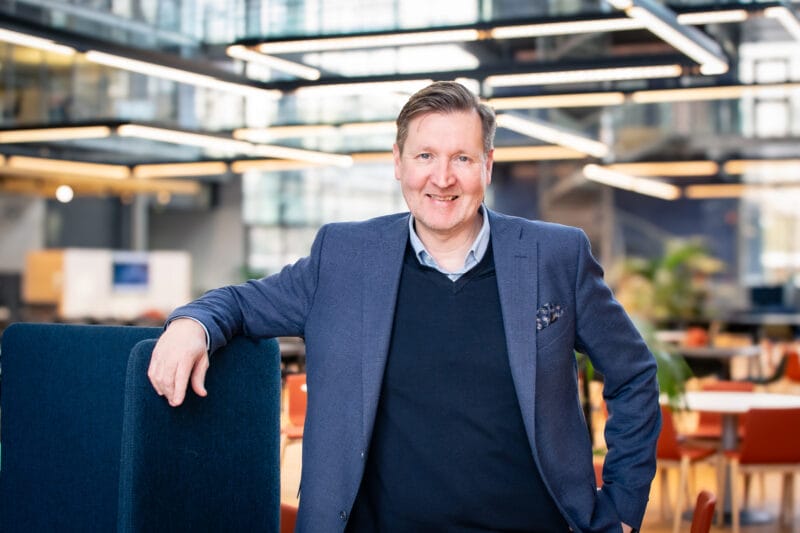
Author
Sami Karkkila is the CEO of Sofigate and a true growth leader with extensive experience in leadership and business development across both Finnish and international companies. Since taking the helm in 2014, Karkkila has led Sofigate through a remarkable growth journey, during which both the company’s headcount and revenue have multiplied.
Sami is known as a people-centric and strategic leader who excels at connecting technology with business needs to create customer-driven solutions. He is at his best working alongside clients: his core expertise lies in helping organisations find their direction toward more sustainable, future-oriented operations and in identifying how they can enhance their performance through AI.
From secret agents to an agent factory

Building purpose through partnership
