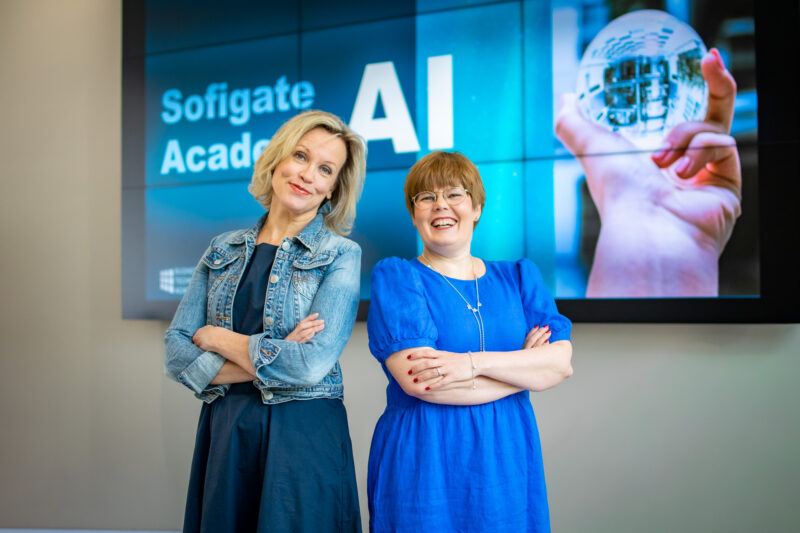
“When hard work is no longer enough” – how six young talents are building AI tools for youth employment
In today’s job search, success is no longer just about hard work or skills. As artificial intelligence reshapes the playing field of working life, the path from the starting line to a first job in one’s field can break down – unless employers change the rules of the game. In Sofigate’s Impossible/Possible experiment, Lassi Kurkijärvi and Jawahir Ahmed argue that AI should not replace young people but create new opportunities for them.
“I’ll get a job straight away as an engineer.”
This is how Jawahir Ahmed recalls thinking when she moved from a business background to study automation and robotics at Aalto University. As graduation approached, however, her vision of a future career path began to shift: a new technology, generative AI, was disrupting the labour market. Headline after headline suggested it would soon handle the work of young professionals.
“The development of AI seemed to be changing the nature of work and expectations in my field very quickly. I had to stop and think about what this change means not just for me, but for my entire generation,” she says.
Since then, Ahmed has secured an interesting role and a unique opportunity to influence the AI-driven transformation of working life. She is one of six early-career talents recruited by Sofigate into an ongoing experiment. The aim is to test in practice how AI can genuinely help young people in their job search, in shaping their career direction and in gaining a foothold in working life.
“Working life needs to be rebuilt”
Media headlines paint a bleak picture of AI: it has become part of working life, yet it is also pushing people out of it. Increasingly, AI development is cited as a reason for change negotiations, and particularly entry-level roles are said to be at risk, or at least changing radically.
According to Sofigate’s Executive CTO Lassi Kurkijärvi, it isn’t AI that decides on layoffs, but people. And people’s perspective on this change is still flawed in many places: leaders are trying to optimise when they should be maximising.
“People at the start of their careers have a lot to offer. The question shouldn’t be whether their work can be optimised away, but how working life needs to be rebuilt. We need to challenge what entry-level work should actually look like,” he says.
Kurkijärvi points to a deeply ingrained assumption in working life: that a “junior’s” path typically involves manual effort and routine tasks. In a law firm, this might mean reviewing stacks of contracts; elsewhere, updating databases or performing repetitive tasks.
These tasks can – and should – be automated, Kurkijärvi says. This frees up time for people to focus, even early in their careers, on more meaningful work that requires interaction and creativity. He encourages leaders to consider a question that often turns their thinking upside down.
“What would you do if you had ten thousand new employees? What more could you achieve if AI freed people from routine work and gave them access to a digital workforce?”
It’s AI natives turn now
Are young professionals entering the workforce today – and the six people in Sofigate’s Impossible/Possible experiment – facing an entirely unprecedented challenge? Not quite.
Kurkijärvi himself took part in a similar experiment at the age of 18. In the late 1990s, a group of digital natives were hired to explore what the internet would mean for media companies.
“Now it’s the turn of AI natives. For those of us used to today’s working life, business leaders in our forties, it’s important to make space. Even I notice that it can be hard to imagine how things could be done differently. People get used to routines,” he says.
Ahmed also emphasises the importance of having those involved who have grown up with AI as part of their environment.
“We shouldn’t be seen only as users of AI. The tools being built now are part of the structures of future working life, so they need to reflect our generation’s expectations, experiences and needs.”
During their first month, the Impossible/Possible team has already met both employers and young job seekers. Workshops are also planned, where young people can test and give feedback on the AI agents currently being developed.
No ready-made answers
Ahmed describes how, within her network and the experiment team, hundreds of job applications have been sent without results.
“The idea that hard work alone is enough no longer holds. It shifts responsibility incorrectly onto young people.”
The team is already developing its first agents to support tasks such as identifying personal strengths, structuring applications and mapping out next steps. The starting point is clear: the agents must not provide ready-made answers.
“Even though AI is already an everyday tool for many, using it is not the same as competence. It requires the ability to question and evaluate responses. Our thinking is that a good agent doesn’t give answers, but helps you ask better questions,” Ahmed explains.
Ahmed highlights two opposing risks that appear at the same time: for some, excessive reliance on AI and “cognitive offloading”; for others, being left outside these tools altogether, creating a growing digital divide.
“Some people are already outsourcing too much of their thinking, while others risk being left without tools or skills. It’s important for us to consider both extremes in our solutions,” she says.
Kurkijärvi sees the risks from the employer side as well: companies are already drowning in generic, AI-assisted job applications. The challenge for the team is therefore to develop solutions that support a young person’s own thinking, not replace it.
“The problem is not a lack of capability among applicants. The quality of candidates in our experiment was exceptionally high. In fact, we ended up hiring six instead of the planned five. It was the right decision: we brought together six smart individuals who complement each other and are not afraid to ask difficult questions or tackle difficult issues,” Kurkijärvi says.
Human uniqueness as a superpower
Both Kurkijärvi and Ahmed return to the same idea: AI should not be used to replace or standardise people.
“AI is a good servant, but a bad master,” Kurkijärvi summarises.
Ahmed adds that the more widespread AI becomes, the more valuable our humanity will be. The experiment aims specifically to support the identification of personal strengths and capabilities through AI.
“A person’s superpower is that they are unique as they are. That’s why the value of AI is not in what it does for us, but in what it helps us see in ourselves,” she says.
Their key insight is this: if hard work alone no longer guarantees a job, the solution is not simply to tell people to apply more. We need to ask what kind of work we are building, for whom, and on whose terms.
Click to meet the full Impossible/Possible team!
Experts interviewed
Jawahir Ahmed is a student of automation and robotics at the start of her career who has complemented her studies with computer science and business. She works in Sofigate’s Impossible/Possible experiment, developing AI solutions to support job seeking. She is particularly interested in how technology can support human thinking and agency – not replace it – and in how the future of work can be built responsibly and equitably.
Lassi Kurkijärvi has been building digital business for three decades. Today, he helps Nordic companies navigate digital transformation at Sofigate in the role of Executive CTO. His passion is humanity in all its forms: change either ignites or fades depending on whether people are inspired and committed to it, and ultimately everything new must serve a better and more sustainable life.
Six questions reveal whether your company’s AI transformation is on solid footing

AI will not transform business. People will.