Leader, don’t start with AI – start with the problem
In Konnevesi, the starting point was not to build a grand AI vision, but to solve one practical problem. Sofigate’s Sami von Wehrt and Mikko Hupli say many companies could learn from the small municipality: in AI, the point is not to reach for the moon, but first to get one sensible solution into production – and then replicate it elsewhere.
Finnish municipalities, agility and permit processes do not usually belong in the same sentence.
Sofigate’s Sami von Wehrt also remembers applying for permission to build a fence at his detached house. The permit process was anything but light.
“The fence had first stood in the same place almost 200 years ago. Even so, getting permission for a new fence felt like the hardest thing in the world,” he says.
It is easy to smile at the slowness of municipalities. From a resident’s point of view, dealing with them still often means paperwork, stamps, forms and waiting, says von Wehrt’s colleague Mikko Hupli.
“That is why Konnevesi is such an interesting exception. In the small municipality in Central Finland, they set out to tackle the inefficiencies of administration with automation and AI, in a practical way and one process at a time. There is a lot many companies could learn from that,” Hupli says.
AI waits for no one
In companies, AI is often discussed in grand terms. Roadmaps are built, working groups are set up, pilots are launched and strategies are drawn up. All of that is necessary in its own way.
Yet Hupli sees only a small number of solutions actually taken into production in companies – and many projects that are made so broad that decision-making starts to consume time, money and energy.
“Companies spend an absurd amount of time, and therefore money, on decision-making when things are made big and complicated. They try to solve a large whole all at once,” Hupli says.
According to him, the problem is not only slowness. The problem is that change never stands still.
“Companies easily turn AI into a never-ending cathedral project. By the time they finally get results, the world has already changed so much that those results are no longer relevant.”
Konnevesi reduced manual work by 85 per cent
The municipality of Konnevesi did not set out to build a grand AI strategy. Instead, it decided to solve one everyday administrative problem first. The chosen target was the processing of private road grant applications, where customer service was getting bogged down.
“This is work that municipalities often do alongside everything else. Applications come in by the dozens or hundreds, they are checked manually, decisions are prepared over weeks if not months, and the resident waits,” von Wehrt says.
With Sofigate, the process was rebuilt. Processing was automated on the Salesforce platform so that the same solution can later be used in the municipality’s other services as well.
In the pilot, the working time spent on processing private road grants fell by around 85 per cent. Work that used to take weeks is now completed in a fraction of the time.
Von Wehrt emphasises that for small municipalities, AI is not only about efficiency. It is a question of long-term vitality. Administrative employees are retiring, young people are moving to larger cities and the service needs of an ageing population are growing. At the same time, administrative work should be managed with ever scarcer resources.
“When a trained employee spends their time copying applications, checking them and filling in Excel, the work does not attract young talent and the service does not improve. The same applies to companies,” he says.
Don’t settle for “AI-ing” the current process
In the Konnevesi project, the use of AI was not an end in itself or the starting point, nor was old work simply handed over to AI as it was. That is exactly what organisations should not do, von Wehrt warns.
“If the current process is messy or unnecessarily heavy, AI will not automatically make it better. If you automate the existing operating model with AI, you are only sprinkling AI dust on top of it,” he says.
Many organisations come to a supplier with a ready-made request: make this existing process digital.
“Instead, they should say what outcome they want and ask how to get there in the smartest way. A good partner comes up with the solutions and starts from the process, not the AI,” Hupli says.
Perfection is an expensive goal
For business leaders, the lesson from Konnevesi is simple: not everything has to be perfect before it can be useful.
Von Wehrt has given his customers the same advice for decades. Organisations often say that an off-the-shelf solution will not work for them because their projects are handled case by case. In his view, that claim is rarely entirely true.
“A large share of processes are very similar. You buy, you sell, and you do things around those activities. Even across industries, many things are almost identical,” he says.
Still, companies customise. And customisation costs.
“Eighty per cent of the functionality can cost 20 per cent. The final 20 per cent can easily cost 80 per cent. The most important thing is to start with what solves a sufficiently large problem well enough,” von Wehrt says.
The world is looking at Konnevesi
The Konnevesi project did not remain a one-off pilot. Around it, a nine-municipality More with Less project, funded by Sitra, has been built to take the same thinking forward together. Solutions are developed on a shared Salesforce platform so that the lessons and benefits do not remain within a single municipality.
Joint development also shares the costs: while a 100,000-euro investment would be expensive for one municipality, divided between several it becomes only a fraction of that.
The example of Konnevesi has also begun to attract interest outside Finland. In Norway, people have already spoken of “Norway’s Konnevesi”. In Sweden, Italy and Spain, discussions have been held on whether the same thinking could work there too. In Southern Europe in particular, the scale is enormous: thousands of municipalities do the same things in their own ways and with their own systems.
Too often, we look abroad when searching for examples of digitalisation, AI and the renewal of public administration, Hupli says.
“Perhaps the finest AI use cases do not always have to be found in Silicon Valley, London or Stockholm. Right now, it is worth looking at Konnevesi and small Finnish municipalities.”
Experts interviewed:
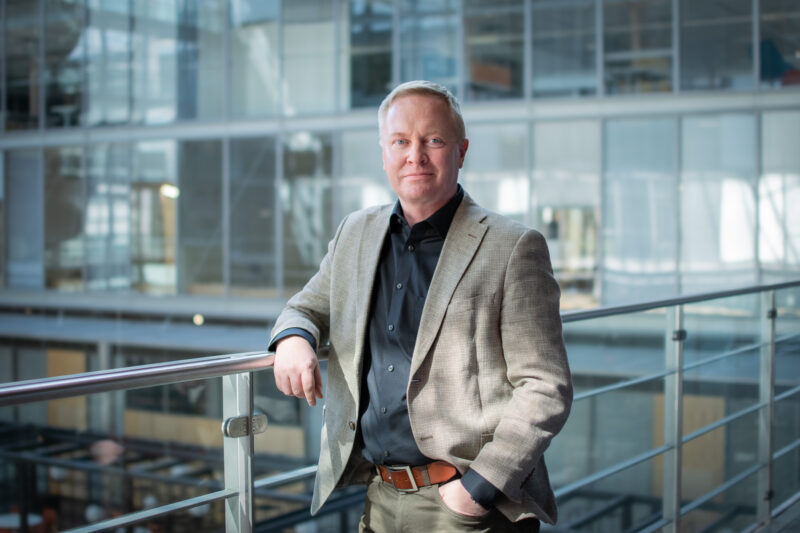
Sami von Wehrt is a Senior Executive at Sofigate who works with the More with Less project and has been involved in building the project concept with Konnevesi from the very beginning. He has extensive experience in developing business, processes and technology in Finnish and international companies.
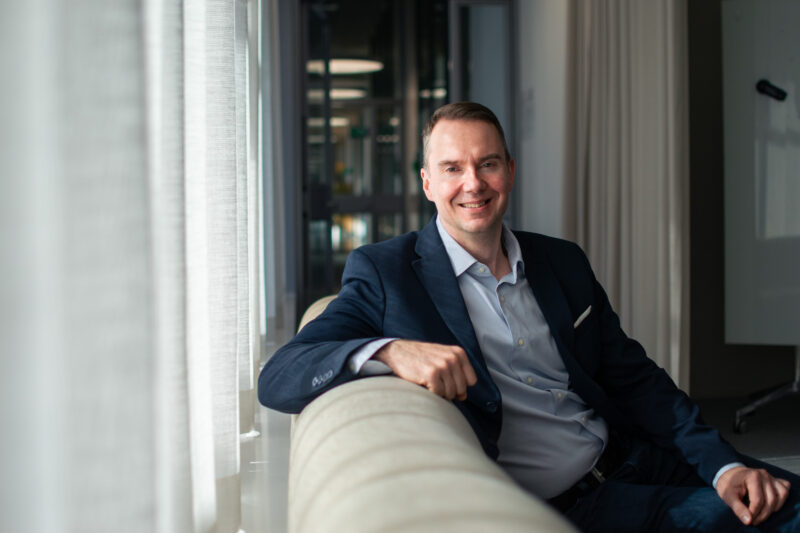
Mikko Hupli is responsible for Sofigate’s Salesforce business. He has more than 25 years of experience in digital development, customer relationships and technology projects in large companies. Hupli looks at the adoption of AI particularly from the perspectives of leadership, scalability and business value.
AI solved one problem, but it exposed another

Companies are looking for AI-era talent using old-world measures