Six questions reveal whether your company’s AI transformation is on solid footing
Three out of four organisations still use AI to automate existing tasks instead of rethinking how work is done. Sofigate’s Juho Nevalainen and Maria Uusitalo challenge leaders to look beyond savings: optimising the wrong work can make a company faster, but not necessarily more competitive.
Few companies have a clear picture of what work should look like in the future, when people and digital co-workers operate side by side. Fewer than one in five companies are actively discussing a future in which digital workers outnumber human employees.
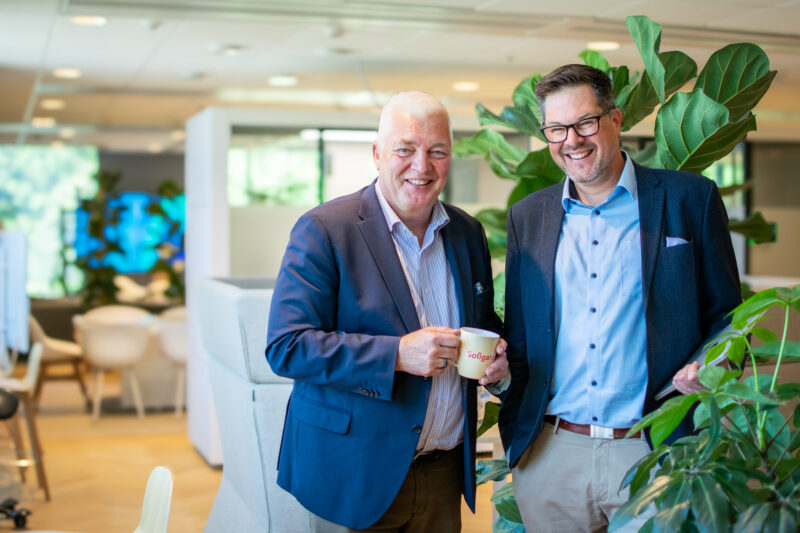
These trends emerge from a playbook compiled by Sofigate in spring 2026, based on observations from more than 60 organisations. Juho Nevalainen, who leads Sofigate’s Enterprise AI Services, and Maria Uusitalo, an expert in human-centred design, recognise the same patterns in their work with clients.
“AI is often simply layered on top of existing processes. That means taking old ways of thinking into new technology instead of genuinely redesigning work with AI,” Nevalainen says.
According to Uusitalo, a kind of “AI-era FOMO” is making companies rush: there is a sense that solutions must be put into production immediately to avoid being left behind.
Helping organisations slow down and have the right conversations is familiar territory for Nevalainen and Uusitalo. That is why they have been involved in defining six core questions at Sofigate that every leader should consider before making major moves.
1. What value do you create for your customer?
AI initiatives often start with the technology: what could we automate, what kind of agent could we build, and how many hours could we save?
The first step should be to clarify what value the company wants to create for its customers and other stakeholders. Why does it exist?
Beyond purpose, AI-related decisions should also be weighed against the company’s values. Uusitalo points to IKEA, which has used AI to make its customer service more efficient, as an interesting example.
“Although the company might perhaps have been able to let go of a large proportion of its customer service staff, it chose to retrain them as interior design advisers. I don’t know the background to the decision, but it appears to reflect a values-based commitment to its people and to keeping them employed. At the same time, they have created entirely new business through it,” Uusitalo says.
2. Do you understand what is possible?
Leaders cannot set sufficiently ambitious goals if they do not understand what the technology can do. According to Nevalainen, however, practical AI expertise often develops first within the IT department and among enthusiastic early experimenters.
“There is little point asking an executive team what it wants to achieve if it does not know what is possible,” he says.
Uusitalo and Nevalainen believe it is normal to see “only slightly outside the box” at first. A good place to begin looking for use cases is therefore in the pain points of current work.
Already today, a social care or healthcare professional can dictate client records, freeing up time otherwise spent typing at a computer. A salesperson can dictate observations immediately after a customer meeting, capturing tacit knowledge and nuances from the conversation as well. What might the next step be?
3. Can you identify the real bottleneck?
Making one stage of work more efficient does not help if it creates a bottleneck in the next.
“In software development, for example, one developer can manage only around ten agents. Beyond that point, decisions and oversight work simply start piling up on their desk,” Uusitalo explains.
The real constraints can only be found by looking closely at the details of the work. How is it actually done in your organisation, why is it done that way, and what would happen if one stage were removed?
At the same time, Uusitalo warns against optimising a workplace to death. A shop’s morning meeting may be replaced by sending information directly to employees’ mobile devices, but that shared moment often serves purposes beyond simply sharing information.
4. Where does your company need more human involvement?
AI discussions often focus on what people should spend less time on. A far more interesting question is what they should spend more time on.
There have been public examples of companies that automated their operations and dismissed a significant proportion of their employees. When customer service staff were let go and customer satisfaction collapsed, staff had to be asked to come back.
“Our client, the Swedish Public Employment Service, has taken a different approach. AI has been put to work handling routine cases, freeing up more time for employees to solve more challenging cases and spend more time interacting with people,” Uusitalo says.
According to her, redistributing work also raises important new leadership questions: when thinking and problem-solving remain with people, how do you ensure that the work stays meaningful without becoming too demanding? What happens to workloads, and how do you support recovery?
5. Do you want more coffee breaks or more productive work?
Every organisation has to decide what to do with the time freed up by AI and automation. Do people spend more time having coffee, or doing something more productive?
In the municipality of Konnevesi, the time spent processing private road grants fell by around 85 per cent in a pilot in which application processing and decision preparation were automated on the Salesforce platform. More time can now be devoted to difficult cases, residents receive decisions faster, and the municipality’s limited staff resources will stretch further in the future as the population ages and demand for services grows.
“Even ‘more coffee breaks’ can still be the right answer to the question of how to use that time. The new pace of work requires more shared discussion, not less. A monthly team session is already far too infrequent when work progresses significantly faster thanks to AI,” Uusitalo says.
6. How do you turn the change into everyday practice?
More than half of the organisations examined in Sofigate’s playbook do not have a complete picture of which AI agents are being used within them. Experiments often emerge across different parts of an organisation faster than governance can respond.
“Governance that is too heavy kills enthusiasm. But without a common model, organisations end up building overlapping solutions without knowing what others are doing,” Nevalainen says.
AI solutions can also provoke resistance among employees, as many people fear losing their jobs.
“Change cannot be driven purely from the top down. People need to be involved in developing solutions from the very beginning so that they feel part of the process. Employees are also the best experts on their own work,” Uusitalo says.
Is it time for your organisation to have these conversations too?
Download Sofigate’s There is no more work without AI playbook. Its AI Value Canvas provides ready-made supporting questions to help structure the discussion.
Experts:
Juho Nevalainen leads Sofigate’s Enterprise AI Services offering and owns Sofigate’s AI development programme. Enterprise AI Services spans Sofigate’s management consulting services and technology solutions.
Maria Uusitalo works at Sofigate as an AI Experience Designer in the Business Renewal team. She examines AI transformation through the lenses of human-centred design, work redesign and change management.
AI will not transform business. People will.
A lesson for leaders: The deliberate AI risk we took